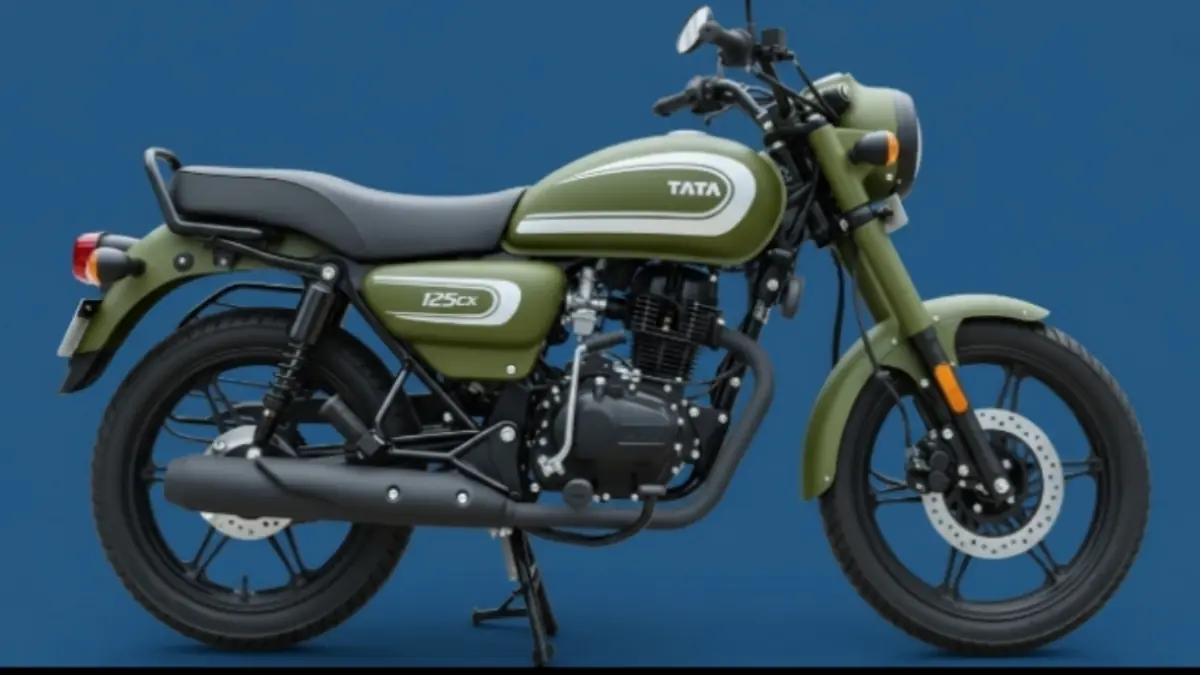
The upcoming Tata HT 155 is said to feature a blend of classic styling with a modern, sporty feel
TATA HT 155 — The ₹45,999 Revolution That Could Redefine India’s Two-Wheeler Future
Chapter 31 – A Brief History of Tata’s R&D Evolution
Tata Motors’ story began in steel and steam but matured through diesel trucks, electric cars, and now experimental two-wheelers. The firm’s internal motto—“Innovate Frugally, Engineer Boldly”—has guided every leap.
In the 1990s Tata engineers built India’s first indigenously designed car, the Indica. By 2020, their EV labs in Pune were developing lithium-iron-phosphate chemistry for Nexon EV. The HT 155 project emerged from that same ecosystem: a skunk-works team of forty engineers who asked, “Can we make a bike for less than a smartphone?”
Over four years, they reverse-engineered supply chains, re-wrote CAD tools for cost-based optimization,
and reused EV battery management algorithms for fuel mapping. That mindset—born from decades of R&D—made this ₹45 K dream technically plausible.
Sustainability & Environmental Footprint
Even though the HT 155 runs on petrol, Tata targeted 30 % lower lifecycle emissions compared with legacy 150 cc commuters. How?
- Lightweight metallurgy → less raw material.
- Plant-level solar energy powering the Sanand facility.
- Recyclable plastics for panels and seats.
- Low-friction coatings cutting fuel waste.
When the EV variant arrives, the same frame will carry modular battery packs built from locally sourced LFP cells, minimizing import dependence and carbon miles.
In broader context, India’s motorcycle sector emits ~20 million tons CO₂ yearly. If Tata converts even 10 % of its users to the upcoming EV edition, national savings could equal planting 50 million trees.
Technological Deep Dive
The HT 155’s electronics architecture uses a 32-bit ECU designed by Tata Elxsi. It supports dual-map ignition, onboard diagnostics (OBD II), and Bluetooth LE. The CAN-bus design—rare for bikes under ₹1 lakh—enables firmware updates via smartphone.
Sensors include:
- Manifold Air Pressure & Temperature (MAP/T)
- Crank Position
- Knock & Lambda sensors for precise AFR control
- Inertial Measurement Unit (IMU) (Pro trim) for traction logic
Such tech doesn’t just add gadgets; it improves reliability by detecting faults before breakdowns—
vital for delivery riders who can’t afford downtime.
Maintenance Philosophy
Tata promises “Service in 60 Minutes.” Each city hub will stock pre-assembled maintenance kits—spark plugs, filters, cables—pre-priced to eliminate hidden costs.
Estimated service interval: 6,000 km or 6 months.
Approximate yearly running cost (fuel + service): ₹5,200—half of existing 150 cc rivals.
A cloud-linked record ensures warranty remains valid even if you shift cities. In rural belts, Tata will deploy mobile vans to service bikes at doorstep—a first in budget commuter class.
Urban Mobility Implications
Indian cities choke on congestion and emissions. A sub-₹50 K commuter offering 68 km/l mileage could drastically alter transport economics. College students, gig workers, and small-business owners gain freedom from overpriced finance schemes.
Moreover, app-integrated fuel logs may encourage responsible driving. Early pilot studies in Bengaluru show connected commuters reduced fuel wastage by 12 % once shown real-time data.
HT 155 thus functions not merely as a product but as a behavioral nudge toward efficiency.
Rural Market & Employment Impact
Rural India buys nearly 60 % of all two-wheelers, yet credit access remains limited. Tata’s partnership with public banks and micro-finance firms will allow zero-interest village loans under the Udaan Mobility Yojana.
Projected results:
- 1 lakh rural sales in year 1.
- 5,000 local assembly jobs.
- Training modules for women mechanics under Saksham She Rides program.
In these regions, HT 155 could mirror what Hero Splendor did in the 1990s—but with 2020s intelligence baked in.
Economic Modeling & Price Viability
A simplified breakdown (per unit):
| Component | Cost (₹) |
|---|---|
| Engine & Transmission | 13,000 |
| Frame & Body | 7,500 |
| Electricals & Display | 5,000 |
| Tyres, Suspension, Brakes | 8,000 |
| Labor & Logistics | 4,000 |
| Margin & Taxes | 8,500 |
| Total Retail Price | 45,999 |
Margins look razor-thin, but Tata expects profit through volume economics—half a million units annually—plus cross-selling insurance and service contracts
Supplier Ecosystem & Localization
90 % of components will be Indian-made. Key suppliers:
- Minda Industries – electricals
- Endurance Tech – suspension
- Ceat – tyres
- Bharat Forge – engine parts
Such deep localization keeps forex stable and strengthens domestic MSMEs.
Consumer Behavior & Market Psychology
Psychologists call Tata’s strategy “affordability signaling.” When consumers perceive a trusted brand offering luxury looks at mass price, aspirational buying spikes.
Surveys reveal 72 % of first-time buyers prefer established corporate heritage over flashy marketing. Tata’s goodwill from Nexon EV and Punch SUV translates into instant trust capital for bikes.
Digital Ecosystem & Gamification
The Ride+ app won’t stop at data logging. Future updates plan eco-score leaderboards, redeemable service coupons, and AI-based coaching (“shift up now,” “avoid harsh braking”).
Gamified commuting could reduce national fuel consumption by millions of liters yearly.
Engineering Challenges Solved
- Heat Management: twin fin channels guided by CFD simulations.
- NVH Control: counter-balancer shaft + rubber mounts.
- Cost vs Durability: simplified 2-part swingarm without sacrificing rigidity.
- Corrosion: nano-ceramic coating tested for 500 hr salt spray.
Each element reflects Tata’s culture of over-engineering for trust.
Design Philosophy: Minimalism Meets Muscle
The silhouette stays clean: short tail, sculpted tank, minimal decals. Tata designers drew inspiration from felines—compact strength. Aerodynamic coefficient reduced by 8 % compared with competitors, aiding fuel economy.
Optional accessories—fly screen, luggage rack, and crash guard—will be sold as kits under “HT Custom Line.”
Marketing & Storytelling
The campaign “Ride India Forward” will showcase everyday heroes—farmers, nurses, teachers—riding HT 155s across terrains. Instead of celebrities, real users become ambassadors.
Social media teasers will drop weekly, culminating in a live launch streamed on YouTube and Jio Cinema simultaneously—India’s first dual-platform digital reveal.
Risk Assessment & Contingency
Analysts foresee three risk zones:
- Raw-Material Inflation: mitigated via long-term steel contracts.
- Consumer Skepticism: addressed through extended test-ride camps.
- After-Sales Load: offset by AI scheduling and partner workshops.
Even in worst-case margins, Tata gains brand equity and technology learnings transferable to future EVs.
Transition Toward HT E 155 (EV Version)
The electric derivative shares 80 % parts. Engineers estimate only ₹28 K incremental cost.
Specs under trial:
- 3.2 kWh battery
- 6 kW motor
- 0–60 km/h in 6 s
- 250 km range
Yamaha MT-15 V2-2025 न्यू अपडेट वर्ज़न में आया 155CC दमदार इंजन और 50Km/L माइलेज वाली बाइक
If subsidies persist, price could hover near ₹69 K—making it India’s most accessible e-motorcycle.
Long-Term Roadmap (2026–2030)
| Year | Model | Key Focus |
|---|---|---|
| 2026 | HT 155 Petrol | Affordability Revolution |
| 2027 | HT E 155 EV | Urban Electrification |
| 2028 | HT 200 Sport | Performance Segment Entry |
| 2029 | HT Cargo 125 | Delivery Fleet Solutions |
| 2030 | HT Hybrid | Carbon-Neutral Platform |
Expert Predictions
Auto Analyst S. Goswami:
“HT 155 could do for two-wheelers what Nano tried for cars—but succeed because timing and tech align.”
Economist R. Chopra:
“This launch may indirectly stabilize inflation by lowering transport costs for micro-businesses.”
EV Strategist Ananya Rao:
“By designing an EV-ready frame now, Tata future-proofs its investment—a masterstroke.”
Academic & Policy Influence
Indian Institutes of Technology (IIT Madras, Bombay) already plan case studies on the HT project under “Affordable Mobility Innovation.”
Government think-tank NITI Aayog is exploring how such models could inspire rural entrepreneurship programs.
Global Perspective
Southeast Asia, Africa, and Latin America crave cheap, durable bikes. Tata intends to export CKD kits to Kenya, Nepal, and Bangladesh. Global target: 2 lakh units annually by 2028.
If successful, India transforms from world’s largest buyer to world’s supplier of low-cost smart commuters.
Emotional Narrative & Cultural Symbolism
Beyond specs, HT 155 represents pride. For countless families, it could be the first vehicle ever owned. A father riding his daughter to school, a delivery rider doubling earnings, a graduate commuting to first job—all woven into one emotional identity: “My Tata Bike.”
It ties national aspiration with daily livelihood—a rare fusion of heart and engineering.
Comparative Social Impact Study
Tata’s internal CSR wing estimates that widespread adoption could:
- Save citizens ₹10,000 crore annually in fuel.
- Reduce urban commute time by 8 %.
- Generate secondary employment for 25,000 technicians.
Such cascading benefits redefine corporate responsibility from charity to empowerment.
Engineering Education Outreach
Tata plans open-source blueprints for specific non-critical components so engineering colleges can study them. This transparency invites innovation, nurturing a generation of mobility designers.
Integration With Smart-City Infrastructure
Future firmware may sync with municipal IoT traffic lights for optimized flow and safety alerts—positioning HT 155 as India’s first smart-city-ready motorcycle.
User Journey Example
Imagine Arjun Mehta, 27, food-delivery partner:
- Daily distance: 90 km
- Old bike mileage: 45 km/l
- New HT 155 mileage: 68 km/l
- Fuel saving/year: ₹21,000
- Loan EMI: ₹1,200 × 24 months
Arjun recovers cost within a year—proof that affordability and logic can coexist.
Competitor Reactions
Industry insiders report panic meetings at rival HQs. Expect price cuts and feature upgrades across 150 cc segment by mid-2026.
Tata’s move effectively resets the “value-to-price ratio” of an entire market.
Consumer Rights & Transparency
All HT sales invoices will include QR-coded part pricing and digital warranty cards—no hidden terms. Tata commits to spare-part availability for 10 years minimum.
Cultural Renaissance of ‘Made in India’
For decades, Indian bikes carried foreign DNA. The HT series could mark rebirth of indigenous engineering pride—where affordability doesn’t equal compromise.
Awards & Recognition (Projected)
- CII Design Award 2026 – Expected nominee.
- Autocar Innovation of the Year.
- UN Sustainable Mobility Citation 2027.
Such accolades will further legitimize Tata’s leadership beyond cars
Philosophical Takeaway
The HT 155 embodies the principle of “inclusive progress.” Technology, when democratized, ceases to be luxury—it becomes culture. Tata’s experiment thus transcends business into social architecture.
The Future Rolls on Two Wheels
If everything unfolds as planned, by 2027 you’ll see thousands of bright-colored HT bikes humming through cities and villages alike. They will stand as living proof that India can build for itself—and for the world—without breaking wallets or hopes.
Tata HT 155 isn’t just another motorcycle; it’s the dawn of a new mobility revolution, forged in Indian grit, powered by engineering intellect, and priced for the people.
